


60th Anniversary celebration sermon
In our second reading we heard St Paul telling us to ‘put on’, as if they were forms of clothing, ‘compassion, kindness, lowliness, meekness, and patience’. We hear these words in the context of this weekend’s closing celebration of the founding of St Cross College. I think not many people today associate Oxford colleges with compassion or kindness, still less with meekness, and probably not with patience either. But the popular image of our university is often mistaken, and St Cross has characteristically, though not of course uniquely, been a place where these unlikely virtues have been and are found.
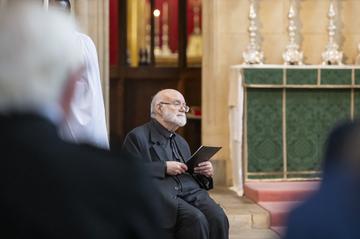
St Crossers, as we are known, are most grateful to the Principal of Pusey House, whose buildings we share, for making their Evensong today also a celebration of the College and of the partnership between the College and the House. My name is John Barton, and I was a Fellow from 1974 to 1991. The College doesn’t officially have a chaplain, but being a Fellow, anyway, and an Anglican priest, I did such chaplaining duties as the College needed, both in its original home, the legendary Wooden Hut on St Cross Road, and then here on St Giles. I want especially to thank the Principal for inviting me back to preach today in this chapel, which I used to attend when I was an undergraduate at Keble in the 1960s.
Oxford of course is full of anomalies if compared with what might be called normal universities, and I sometimes think we could offer an Oxford Anomalies course. Anomalies 101 would teach people that Oxford has a college where the Fellows are called Students, a college that has no students, and a college where the scholars are known as Postmasters—this last being Merton, which gave us our Vice-Chancellor whom we’re so glad to welcome to our celebrations, and where I was once a Junior Research Fellow and Assistant Chaplain, and was ordained in the wonderful chapel.
But explaining St Cross would demand a more advanced, second-year module. The question I’m most frequently asked is probably ‘Who was St Cross?’ though many people know that it means ‘the holy cross’, sancta crux in Latin. But then, people ask, presumably it’s a theological college or seminary? No, the name is purely geographical, because its original home was on the site of the vicarage of St Cross Church. But it shares buildings with Pusey House, which is indeed a religious foundation, and the priests who run the House are also Fellows of the College. At this point in such conversations the questioner normally says, ‘Oh, so that must be how you, an Anglican priest, come to be linked to St Cross’—an obvious, but erroneous assumption. My job brought with it a Fellowship at St Cross, so it’s a coincidence. St Cross is a secular college with members in a huge range of subjects and no special emphasis on Theology.
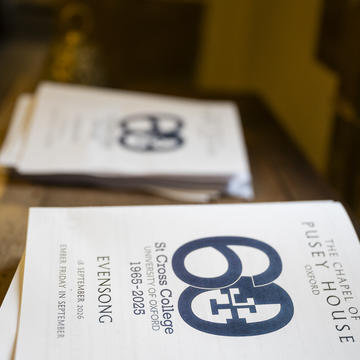
Nevertheless, the college has always, anomalously, had some space for religion, broadly defined. It’s decided to celebrate this significant anniversary with a church service, as it did its foundation in 1965 and its twenty-fifth anniversary in 1990. The College was involved in the beginnings of the Centre for Hebrew and Jewish Studies, and of the Islamic Centre, and of the Ian Ramsey Centre for Science and Religion, as well as becoming linked to Pusey House. Not all members liked these links with religion, but most took a gently accepting attitude, following the example of our first Master, Kits van Heyningen, who encouraged in this new college a generous tolerance of opinions in this as in many things. I remember going to hear him speak about the then not much discussed topic of religion and science in 1966, when I was an undergraduate, with no idea that he was the head of a brand-new college, let alone one I would one day join.
St Cross was founded with invaluable support especially from the colleges commemorated in our Four Colleges Arch—Christ Church, Merton, St John’s, and All Souls. Without their financial help, and their willingness to offer practical advice in piloting the project through the many university committees involved, there would be no St Cross. For there was also opposition to this new kind of college, created to provide a home for academics in subjects no undergraduate college needed a Tutorial Fellow in, and also for the expanding number of graduate students, whose needs for a college home were often poorly catered for. Some in Oxford didn’t see the need, or like this way of meeting it even if they did. Even today we’re occasionally reminded that we are not yet strictly speaking a college at all, but legally a department of the university: as someone once said rather archly to me, ‘You’re not even a Permanent Private Hall’, thereby managing to insult two of the three categories of collegiate bodies in Oxford at the same time. As in retirement I’m now a Fellow of Campion Hall, I was conscious of receiving both barrels.
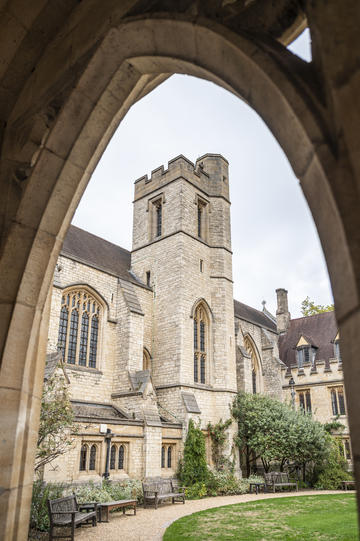
But those who have experienced the real collegiality of St Cross, as also of the other graduate colleges, the PPHs, the various centres, and institutions such as Pusey House that may not even technically belong to the university yet contribute to it, know that these bodies, little known beyond circles where ‘Oxford’ means simply ‘a place where undergraduates are taught’, all enrich our university, which is untidy and full of anomalies because it has grown organically rather than being designed. Each college, hall, society, or centre has its own ethos, which all the members gradually internalise, as a sociologist would no doubt predict, despite the fact that their membership is often accidental or random. St Cross was always marked by an informal warmth and lack of pomposity, and by its pioneering spirit in modelling a style of collegiate life in Oxford not better than that of the traditional colleges, but different. The difference was symbolised by something that may sound like a detail, but which anyone who knows Oxford will immediately recognise as part of a whole cast of mind: having no high table, and one common room for all, students and Fellows alike. It was through conversations with both colleagues and students in the limited and provisional surroundings of the wooden hut, with its simple home cooking, that I learned how to be an academic. The people who made me welcome there mostly exemplified St Paul’s virtues: compassion, kindness, lowliness, meekness, and patience. From my very first day in the College, when I unintentionally stole a Founding Fellow’s umbrella but thus made a new friend, I knew I’d come home. Like the Tardis, the hut was mysteriously larger inside than out.
St Cross was not and never will be a religious college in any strict sense, and I don’t think anyone would want it to be—certainly I wouldn’t. But if we value the ways of behaving towards others that our reading encourages, they could be found there in abundance, and still can. Over the years it’s rather rejoiced in being, as another detractor once commented in Churchillian style, ‘a modest college with a lot to be modest about’. That’s the kind of jibe that returns on the speaker, if we reflect on how excellent a virtue modesty really is, and how fortunate St Crossers are to be part of a college where a proper Oxford striving for academic distinction sits alongside humility. This St Cross brand seems to persist even as the college expands and develops, from the tiny society I joined in 1974, when there were about nine students, to the huge one of today. To sum it up in the kind of southern English I speak, the great thing about St Cross is that though it’s academically distinguished, it isn’t at all grand. But if I may borrow a more northern use of the word, it is an absolutely grand college. May God bless and prosper it.
John Barton
Emeritus Fellow
(Senior Research Fellow, Campion Hall, Emeritus Oriel & Laing Professor of the Interpretation of Holy Scripture, and Emeritus Fellow of Oriel College)

